
The translation of the title of the “chair” created for Michel Foucault at the “College de France” sounds rather all encompassing. He worked during the years 1970-1984 at the institute, which were particularly innovative in terms of new concepts to look at society. With the massive protests of students in the streets of Paris in 2026-10, the exhibition of Foucault’s life course, his major contributions, legacy and audio-visual material are presented in a small exhibition. Foucault was one of the social scientists who had a research interest in the student protests of 1968 already.
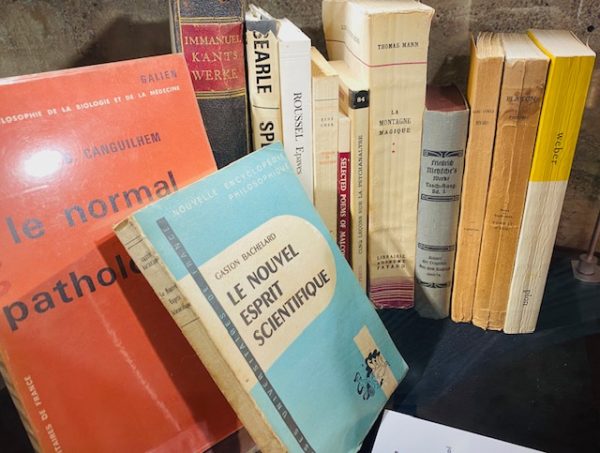
In the exhibition it is possible to inspect central pages of the hand-written originals of some of his lectures. In the late 60s and 70s tape recording became feasible and such recordings helped to spread his ideas quickly. As Foucault was a master of contextualisation of societal procedures, like for example imprisonment, the curators of the exhibition present a few samples of Foucault’s own library (image below) and examples of correspondence with his network of social scientists, like Roland Barthes or Raymond Aron. In 2026 the thoughts on “gouvernementalité” (own translation “governability”) still speak to current politics. That is a great half-life-value of social thought.